
Lessons From Martyrs
Wednesday Walk

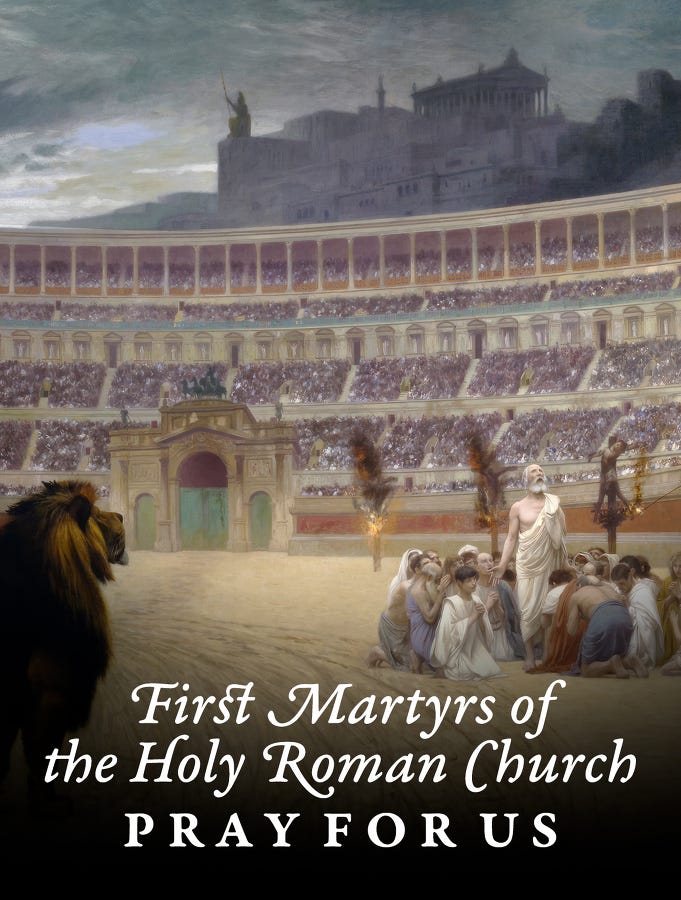
Yesterday, the Church celebrated the Feast of the First Martyrs of Rome, honoring the many early Christians who were put to death under the Roman Emperor Nero following the great fire of Rome in A.D. 64. Their feast comes just one day after we celebrate the two great pillars of the early Church, St. Peter and St. Paul—both martyrs themselves.
These unnamed men and women who followed in their footsteps still have much to teach us today.
“The blood of the martyrs is the seed of the Church.”
— Tertullian
Did you know that the word martyr comes from the Greek word meaning “witness”?
It is difficult to fathom the torture and terror these early Christians endured. Their stories can almost seem like myths or legends, but these were real, ordinary people living ordinary lives until they were asked to make an extraordinary choice.
Would they remain faithful to Christ?
Under Nero’s persecution between A.D. 64 and 68, many were imprisoned, tortured, and executed. By all human reasoning, this should have destroyed the early Church.
Instead, it did the exact opposite.
People watched these Christians face death with remarkable peace, courage, and even joy. They refused to deny Christ, even at the cost of their lives. Their witness caused others to ask, “What kind of faith could inspire such courage?”
Their suffering became the seed from which the Church continued to grow.
So what does that have to do with us?
“What has been will be again, what has been done will be done again; there is nothing new under the sun.”
— Ecclesiastes 1:9
It is human nature to think that our generation faces struggles unlike any before it. But anyone who regularly reads Scripture knows that, at its root, humanity has not changed very much.
The methods may look different. The circumstances may change. But fear, pride, hatred, selfishness, and suffering have always been part of the human story.
And yet so have faith, hope, courage, and love.
As I read the daily Mass readings, I am continually amazed at how often I catch myself thinking, “We really are still just like them.”
Perhaps that should not discourage us. Perhaps it should encourage us.
Because if God remained faithful then, He remains faithful now.
“We rejoice in our sufferings, knowing that suffering produces endurance, endurance produces character, and character produces hope.”
— Romans 5:3–4
The lesson of the martyrs is not simply that they suffered.
It is how they suffered.
They did not respond with hatred. They did not abandon hope. They remained faithful.
That challenges me.
How often do I become upset over the smallest inconveniences? How quickly do I complain, argue, or replay an offense in my mind? Not every irritation needs a response. Not every injustice requires my commentary. Sometimes the strongest witness we can offer is peaceful perseverance.
There are also crosses in life that cannot simply be fixed. Illness. Grief. Broken relationships. Waiting. Loss.
Real courage is often found not in changing our circumstances but in remaining faithful within them.
So where in your life is something broken that cannot immediately be changed?
Perhaps your witness today is simply to keep walking.
One faithful step.
One trusting prayer.
One act of hope at a time.
The early martyrs remind us that faithfulness is often far more powerful than force.
We may never be asked to face lions in an arena, but we all face trials that test our trust in Christ.
If we endure those trials with peace, hope, and confidence in Jesus, perhaps someone watching will begin to wonder what gives us such hope.
And maybe—just maybe—our witness will help lead someone else to Christ.